

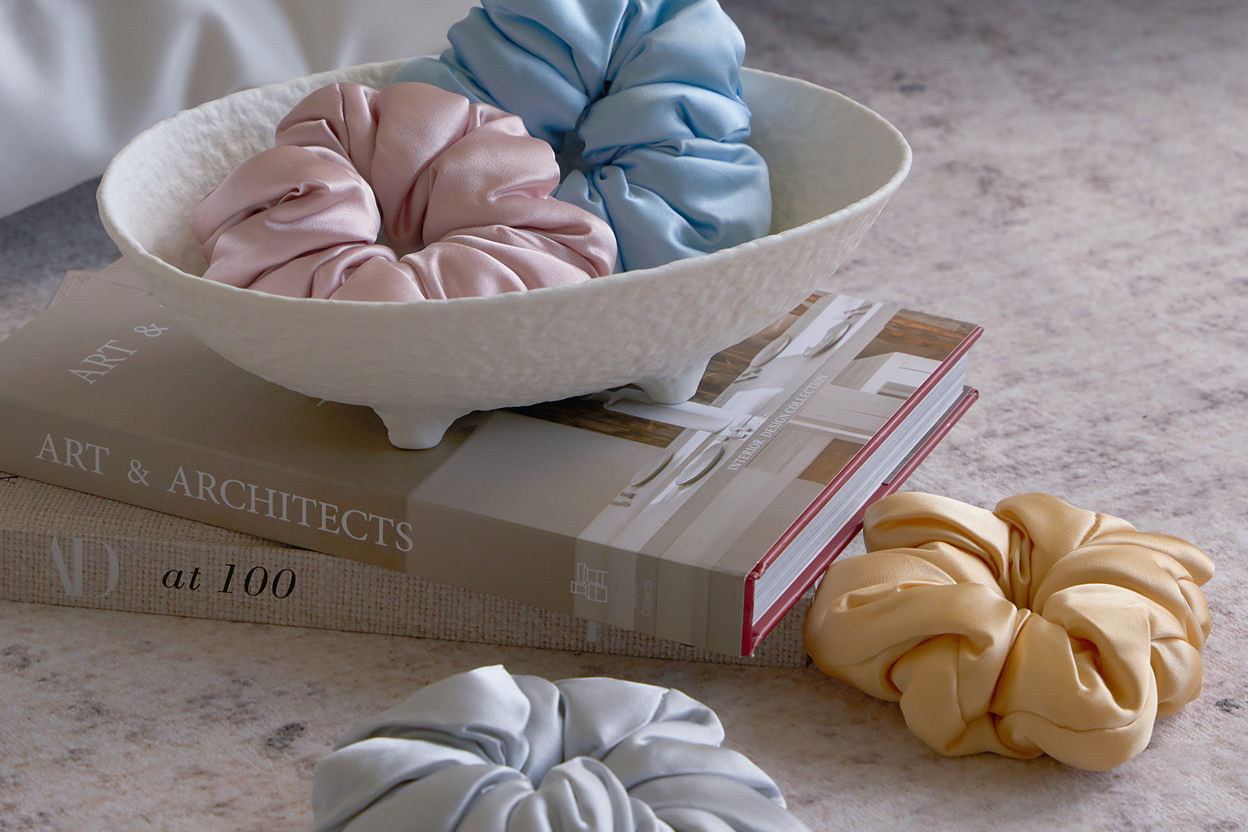
It's easy to overlook a hair tie. It's small, inexpensive, and replaced so often that most people never think twice about it. But the hair tie you use every day — to sleep in, to work out, to pull your hair back during a busy morning — has a real and cumulative effect on your hair health. Switching to a silk hair tie is one of the simplest, most affordable upgrades you can make for your hair. This guide explains exactly why.
What Is a Silk Hair Tie?
A silk hair tie is a hair elastic wrapped or crafted in natural silk fabric — typically mulberry silk — rather than the bare rubber, nylon, or synthetic coatings found on conventional hair ties. The most popular style is the scrunchie or puffed donut shape, which distributes tension across a wider surface area than a thin elastic, while the silk covering ensures that every point of contact between the tie and your hair is smooth, soft, and low-friction.
Unlike the rubber band-style elastics that dominated for decades, silk hair ties are designed with hair health in mind. The fabric doesn't grip, snag, or create the mechanical stress on hair fibers that leads to breakage over time.
Why Conventional Hair Ties Damage Your Hair
To understand why silk hair ties matter, it helps to understand what ordinary hair ties are doing to your hair.
Standard elastics — whether coated rubber bands, nylon loops, or synthetic fabric scrunchies — all share one key problem: friction. When you tie, tighten, or remove a conventional hair tie, the material grips and drags against your hair fibers. Over time, this repeated mechanical stress causes:
● Breakage along the hair shaft at the point where the tie sits
● Split ends and weakened cuticles from repeated pulling and snagging
● Frizz caused by the elastic roughing up the hair's outer cuticle layer
● Creases and kinks left in the hair after removal — the telltale "hair tie dent"
● Thinning at the hairline from elastics that pull too tightly on fragile edges
These effects are cumulative and often subtle — which is why many people don't connect their hair damage to their hair ties until they make the switch and notice the difference.
Benefits of Silk Hair Ties
Dramatically Reduced Friction The surface of mulberry silk is exceptionally smooth at a fiber level — smoother than any synthetic fabric and far smoother than bare elastic. When a silk hair tie makes contact with your hair, it glides rather than grips. This means significantly less mechanical stress every time you tie, adjust, or remove it.
Less Breakage and Split Ends Because silk doesn't snag or catch on hair fibers, the micro-damage that accumulates from daily elastic use is substantially reduced. For people with fine, fragile, color-treated, or chemically processed hair — where the cuticle is already compromised — this difference is particularly noticeable.
No Hair Tie Dents or Creases One of the most immediate benefits people notice after switching to silk hair ties is the absence of the deep crease or kink left behind by conventional elastics. The smooth, low-tension design of a silk scrunchie distributes hold more evenly, leaving hair with far less visible marking when you take it down.
Gentle Enough to Sleep In Many people sleep with their hair tied back. With a conventional elastic, this is a recipe for breakage — the tie creates pressure points against the hair shaft for hours at a time. A silk hair tie is gentle enough to wear overnight without the same damaging effect, making it a popular choice for protective nighttime hairstyles.
Reduces Frizz Every time a rough elastic passes over your hair, it roughs up the cuticle slightly — contributing to frizz, particularly for wavy or curly hair types. Silk's smooth surface leaves the cuticle undisturbed, helping hair look smoother and more defined after styling.
Kind to the Scalp and Hairline The softness of silk means less pulling tension on the scalp and hairline, which is especially relevant for anyone prone to traction alopecia or edge thinning from tight hairstyles. A silk hair tie worn at a comfortable tension is noticeably gentler than its conventional equivalent.
Naturally Hypoallergenic Silk contains sericin, a natural protein that resists allergens and is non-irritating to sensitive skin. For anyone who experiences scalp sensitivity, reactions to synthetic materials, or skin irritation around the hairline, a silk hair tie is a much gentler option.
Silk Hair Tie vs Regular Elastic Hair Tie
|
|
Silk Hair Tie |
Regular Elastic |
|
Friction on hair |
Minimal — smooth surface |
High — grips and snags |
|
Breakage risk |
Significantly reduced |
Accumulates with daily use |
|
Hair creases after removal |
Minimal |
Often visible dents |
|
Safe to sleep in |
Yes |
Not recommended |
|
Frizz |
Reduced |
Contributes to frizz |
|
Scalp and hairline tension |
Gentle |
Can pull and stress edges |
|
Hypoallergenic |
Naturally |
Varies by material |
|
Appearance |
Elegant, polished |
Functional only |
The practical difference is real, not just aesthetic. A silk hair tie holds your hair just as effectively as a conventional elastic — but does so without the daily wear-and-tear that adds up to noticeable damage over weeks and months.
What to Look for in a Quality Silk Hair Tie
100% Mulberry Silk The cover fabric should be 100% mulberry silk — not a silk-feel polyester, satin fabric, or silk blend. Only genuine mulberry silk delivers the full smoothness, hypoallergenic, and low-friction benefits described above. Check product descriptions carefully for fiber content.
Puffed or Donut Shape The puffed donut scrunchie shape is widely considered the best design for hair health. The extra volume means the elastic inside is distributed across a wider surface area, reducing the concentration of tension at any single point on the hair shaft. This translates directly to less breakage and fewer creases compared to flatter or thinner designs.
Quality Elastic Core The elastic band inside the silk covering matters too. It should provide a consistent, reliable hold without being so tight that it creates damaging tension. Good silk hair ties use a well-rated elastic that maintains its stretch over time rather than losing tension or snapping after a few months of use.
Stitching and Construction Look for clean, tight stitching on the silk covering. Loose or unfinished seams can catch on hair just as much as a bare elastic — defeating the purpose of the silk covering entirely.
How to Care for Silk Hair Ties
Silk hair ties are easy to care for and last significantly longer than conventional elastics when treated properly.
● Hand wash in cool water with a gentle, pH-neutral detergent, or place inside a mesh laundry bag for a delicate machine cycle.
● Do not wring — gently press out excess water and lay flat to dry.
● Avoid heat — keep away from hairdryers and direct sunlight, which can degrade silk fibers and weaken the elastic core over time.
● Store loosely rather than stretched around a wrist or bunched tightly, which can distort the shape and stress the elastic.
With proper care, a quality silk hair tie will maintain both its silk softness and its elastic hold for considerably longer than a conventional alternative.
Who Benefits Most from Silk Hair Ties?
While everyone's hair benefits from less friction and gentler daily handling, some people will notice the difference most immediately:
● Fine or thinning hair — where every breakage event is more visible and the margins are smaller
● Color-treated or chemically processed hair — where the cuticle is already more vulnerable to mechanical damage
● Curly and wavy hair — where frizz control and curl preservation are daily priorities
● Anyone who wears hair ties to sleep — where a gentler alternative makes a real overnight difference
● People with scalp sensitivity or hairline thinning — who need a lower-tension option that doesn't stress delicate edges
● Anyone who has noticed a "hair tie dent" — and wants their hair to fall naturally after wearing it up
Why a Silk Hair Tie Is a Small Investment With Real Returns
A silk hair tie costs more than a bag of conventional elastics. But it lasts longer, performs better, and — most importantly — stops doing the quiet daily damage that accumulates into real hair loss and breakage over time.
Think of it as the smallest possible upgrade to your hair care routine. You're already using the hair tie anyway. The only question is whether the one you use is working with your hair or against it. For the cost of a single hair appointment, switching to silk is a change you can make today and benefit from every single day afterward.
Shop the Zensage Silk Puffed Donut Hair Tie
The Zensage Silk Puffed Donut Hair Tie brings together everything that makes a silk hair tie genuinely worth using — 100% mulberry silk covering, a generously puffed donut shape for even tension distribution, and a quality elastic core that holds reliably without pulling.
It's the kind of detail that quietly upgrades your entire hair routine — gentle enough for daily wear, thoughtful enough to sleep in, and beautiful enough to wear as an accessory rather than hide away. A simple change that your hair will thank you for, one day at a time.

Leave a comment
This site is protected by hCaptcha and the hCaptcha Privacy Policy and Terms of Service apply.